Barney Kessel Feeling Free (Contemporary 1969)

Kessel took a U-turn back on the main road to real jazz, Hollywood be damned. 

Personnel

Barney Kessel (guitar), Bobby Hutcherson (vibraphone), Chuck Domenica (bass), Elvin Jones (drums)

Recorded

on February 19, 1969 at Contemporary Records Studio, Los Angeles

Released

as Contemporary M3618 in 1969

Track listing

Side A: Moving Up / Blue Grass / This Guy’s In Love With You / Side B: Blues Up, Down & All Around / The Sound Of Silence / Two Note Samba

Let’s get wild, let’s get wild, is what Barney Kessel must’ve thought. Let’s check out Elvin Jones, tornado that married a volcano, Bobby Hutcherson, adventurous vibraphonist par excellence, and killer L.A. bassist Chuck Domenica, and break on through to the other side.

Kessel, a guy that seemed to be everywhere at once, as unavoidable as a motel sign on the Interstate, was a master guitar player, poll-winner from Muskogee, Oklahoma (Charlie Christian county) from Hungarian ancestry, Los Angeleno that was featured in the groundbreaking short (Norman Granz-produced) film Jammin’ The Blues in 1944, recorded with Charlie Parker in 1947, was part of the Oscar Peterson Trio and the (Norman Granz-produced) Jazz At The Philharmonic tours.

A busy studio bee, aligned with the famed Wrecking Crew. First thing you’ll hear when you put on the influential Pet Sounds by The Beach Boys is Kessel’s melodic line of Wouldn’t It Be Nice.

Lucrative or not, Kessel got tired of the Hollywood assembly line and wanted to get back in the game and play some real creative jazz shit. In 1969, Kessel released no less than five albums! Feeling Free is the hottest, no controversy.

A wild ride, raw and unfiltered. There are moments that aren’t neat, Kessel in a hurry in the thunderstorm of Elvin Jones like a hare taking to its heels and tripping over a rock during Blues, Up Down & Around. That’s jazz, what jazz has been, what it could be: first or second takes only (as Kessel explains in the liner notes), spontaneity, feeling and energy up front.

Energy abound. Kessel’s sound, like the grit between bricks, has the X-factor.  The album’s opening sets the tone, a hip line – Moving Up – some sort of space bossa (super-)nova, developed through the symbioses of Kessel’s fat patterns and sandpaper chords, which in turn contrast with the elasticity of Jones’s time feel, all together now with progressive Bobby Hutcherson, whose notes live by its own offbeat rules, rooted but far out, always tasteful.

They play quirky blues, spice up Burt Bacharach and Simon & Garfunkel with chili pepper and cinnamon. Perhaps in hindsight all these brushwoods and gusty winds are fitting for the era, war across the USA, either way a courageous jump into the deep end by the former Dust Bowl kid, who’d eventually had to stop playing in the early 1990’s because of health issues and passed away at the age of 80 in 2004.

Listen to Feeling Free on YouTube here: https://www.youtube.com/watch?v=YTos1P7IYos&list=OLAK5uy_k0Ba3npCinGv1B3BDGbsIiTg3amL_IeEI
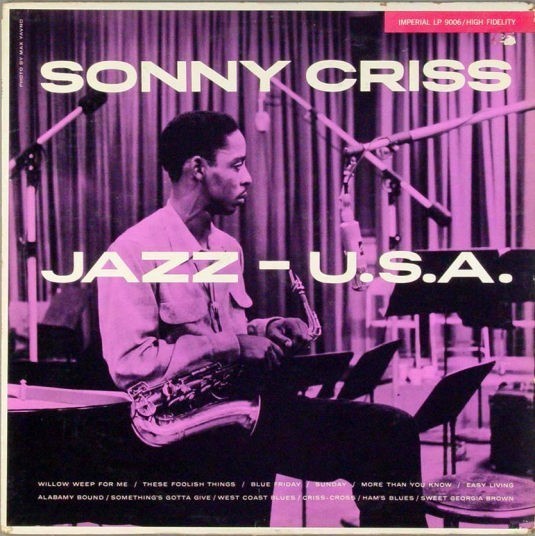
Sonny Criss Jazz U.S.A. (Imperial 1956)

The sessions of Sonny Criss for the Imperial label deserve at least as much attention as his better known Prestige albums of the sixties. They show an alto saxophonist of tremendous power and authority. The uptempo standards on Jazz U.S.A. are particularly overwhelming.

SonnyCriss - JazzUSA

Personnel

Sonny Criss (alto saxophone), Barney Kessel (guitar), Kenny Drew (piano), Bill Woodson (bass), Chuck Thomson (drums)

Recorded

on January 26, February 24 and March 23, 1956 in Los Angeles, California

Released

as Imperial 9006 in 1956

Track listing

Side A
Willow Weep For Me
These Foolish Things
Blue Friday
Sunday
More Than You Know
Easy Living
Side B
Alabamy Bound
Something’s Gotta Give
West Coast Blues
Criss-Cross
Ham’s Blues
Sweet Georgia Brown


Sonny Criss was born in Memphis, Tennessee in 1927 and relocated to Los Angeles at the age of fifteen. Arguably, the bebop virtuoso’s stay on the West Coast in favor of jazz mecca New York hindered his career. Occasionally, Criss played in Paris, to much acclaim, and cogniscenti and colleagues knew where Criss was at. He took to bebop as early as 1947, playing with Howard McGhee, Wardell Gray and Charlie Parker. Touring with Norman Granz’ Jazz At The Philharmonic brought Criss wider recognition in the California area. In 1955, Criss joined the group of drummer/bandleader Buddy Rich. The three albums that Criss recorded for Imperial in 1956, Jazz U.S.A., Go Man! and Plays Cole Porter (the latter two including Sonny Clark) were first class. But it was an ill-fated cooperation. Imperial was an r&b and country label that released, among others, New Orleans r&b artists Fats Domino, Irma Thomas and Smiley Lewis, and country singers like Slim Whitman. Obviously, jazz promotion wasn’t high on their to-do list.

The Prestige albums of the late sixties found Criss laying a thick layer of hard (driving) bop on standards, blues and pop hits of the day. Criss also recorded a couple of solid albums for Muse and Impulse in the mid-seventies. Tragically, in 1977, Sonny Criss committed suicide at the age of 50. The reasons for Criss’ fatal self-infliction by a gunshot remained a mystery for years, until jazz historian Ted Gioia contacted his mother, who revealed that the suffering of stomach cancer had become unbearable for Criss.

Criss modelled himself after Charlie Parker (better said, had the chops to model himself after Bird), but developed an unquestionable personal style. The tone of Criss has a compelling vibrato, in contrast to Bird’s more stripped-down sound. Like Parker, Criss is a virtuoso who doesn’t let his technical prowess overrule the message of his music. He’s got an alluring romantic streak in his playing. Precise, driving phrasing, abundant blues feeling and a cocksure beat are striking aspects of his style.

Criss tears apart standards with deceptive ease. He plunges himself headlong in the uptempo, swing warhorse Sweet Georgia Brown, topping off ear-catching, punchy lines with salient articulation. Kenny Dorham’s Blue Friday has a swing feeling, contrasted by Criss’ agile, multi-note phrases that he brings about with the finesse of a boxer that stings like a bee and dances like a fly. It’s not brute force that drives you into the corner, but a series of dazzling stabs that leaves one breathless, amazed, admiring.

The group, including an elegantly comping Kenny Drew, rises to the occasion on these uptempo tunes. The mid-tempo tunes are more commonplace, certainly as far as the rhythm section is concerned. The combination of Criss and Barney Kessel leads to the album’s (uptempo) highlights, like Sunday, the before-mentioned Sweet Georgia Brown and Criss original Criss-Cross. And Criss and Kessel deliver a flawless unisono theme of Alabamy Bound at breakneck speed, with Kessel lowering an octave at the tag. Kessel’s solo is fleet and vigorating, bebop-swing in full flight.

The medium tempo West Coast Blues, a Sonny Criss tune (not to be confused with Wes Montgomery’s tune), is distinctive for the vigorous embellishment of Criss of a generic 12 bar blues pattern. The ballad These Foolish Things has been played to the bone. Criss skilfully embellishes it with twisty-turny phrases, snake-charming the melody with a blend of skill and infectious energy that still inspires awe after all these years.